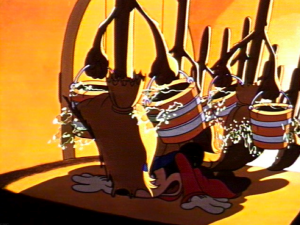
Of all the animals of prey, man is the only sociable one.
Every one of us preys upon his neighbour, and yet we herd together.
The Beggar's Opera: John Gay

Sunday, 22 May 2011

For goodness' sake - it's only meat!

'A lamb which was dumped in a wheelie bin has found a new home - with comedian Paul O'Grady. The month-old lamb, named Winston, was found in the rubbish in Manchester on April 18.

After hearing about its plight*, O'Grady, who already has a small flock of sheep, volunteered to re-home the animal.


The lamb received treatment for an ulcerated eye but was otherwise unharmed. It was bottle-fed by a fosterer around the clock before being transported to O'Grady's property in Kent last week.'

At last, a happy ending; O'Grady, readers may remember, tried unsuccessfully to step in when Marcus (or Market), a sheep reared for meat on a Kent primary school farm, was due for his appointment at the local abattoir and a parent objected, precipitating a media storm.

I think this calls for a song....

A poor little lamb's in the news today,
Baa, baa, baa,
For Paul O’Grady’s got his way,
Baa, baa, baa.
This time he’s pulled all the strings to see
The lamb will be given its liberty
Instead of ending as fricassee,
Baa, baa, baa.


*I have corrected the original Press Association press release which contained - sorry to say - a misplaced apostrophe. What are the requirements for working for a press agency these days?

Saturday, 21 May 2011

The Ballad of Elliot Morley - revisited

With apologies to the Beatles

Elliot Morley
Pays off his mortgage and pockets a cool sixteen grand
All cash in hand;
‘Sloppy accounting’,
All a mistake and there’s nobody else he can blame,
Oh, what a shame!

All the crooked people,
Where do they all come from?
All the crooked people,
Where do they all belong?


Abuse of the system
Siphoning money into his investments for years
Ended in tears;
In mitigation,
Downing Street battles and strife with an enemy there,
A good friend of Blair.

All the crooked people
Where do they all come from?
All the crooked people
Where do they all belong?

Ah, look at all the crooked people,
Ah, look at all the crooked people.


Elliot Morley,
said Justice Saunders, had quite thrown away his good name,
Covered in shame.
Sixteen month sentence,
Convicted for making deliberately excessive claims;
The end of his games.

All the crooked people,
Where do they all come from?
All the crooked people,
Where do they all belong?

Friday, 20 May 2011

Five Signs You Might Be an Apocaholic

It’s a surprisingly common affliction, though I didn’t have a word for it until I found it mentioned online (via Counting Cats), and has been around for a long time in guises ranging from the Book of Revelations to the myth of Atlantis.

Almost all religions have a clear end-of-the-world scenario, while atheists can enjoy comparing the rival claims of asteroid strike (though high priest Lembit Opik seems to have erred from the faith recently), solar flares, mega-quakes or, for the true cognoscenti, methane clathrate release.

It's mostly fairly distant stuff - though there's always the chance a Vogon constructor fleet might pop up out of the blue - unless, of course, you believe Harold Camping's assertions that the end of the world starts tomorrow. However, those apocalyptically inclined might like to feast their eyes on this at Nourishing Obscurity.

Of course, the true apocaholic doesn’t just recognize the possibility of these events occurring; the main symptom of the condition is a warm, happy glow derived from the prospect of complete global annihilation, preferably in a spectacular geological fashion.

It’s not the actual catastrophe that appeals, you understand – apart from anything else, there’s hardly going to be a safe place to stand and watch – but the contemplation of cosmic forces at their most literally awe-inspiring. If that's your sort of thing, you can have hours of fun at Armageddon Online (h/t Demetrius).

Were apocaholism confined to atheists, one might say it fulfilled a deep-seated need to stand in awe of something greater than ourselves – the fact that it transcends religious differences suggests it is rooted in us at a basic level. Who knows; perhaps one day they will isolate an apocalypse gene.

Meanwhile, you know you’re an apocaholic when:

  • There’s a well-thumbed copy of Bill McGuire’s ‘Global Catastrophes’ on your bedside table
  • The US Geological Survey website is on your favourites list and you have a google news alert for 'asteroid'
  • You have a food and water cache under the stairs
  • You watched Horizon’s Armageddon special last week - and, at the end, you found yourself shouting “Tell me something I don’t know!”
  • Deep down, a small part of you is secretly hoping Harold Camping might be right after all
Update: The Filthy Engineer has picked up another possibility. 

Meanwhile, the Urchin has come across a fantastic idea - what if all the workmates and neighbours of Camping's adherents spend tomorrow hiding, leaving the place completely deserted? 
"Hey guys, weren't we the ones supposed to be raptured?"


Thursday, 19 May 2011

and still it goes on...


It's been over a month since my car 'accident' and the phone is still ringing, as company after company try to persuade me that I must have been injured - in a stationary car 'hit' by one barely moving - and should make a claim;

'After all,' they say, 'the other driver has admitted liability. The money will be sitting there waiting for you to claim it.'

Small wonder, then, that these claims are becoming a serious financial drain on the pockets of policyholders. The Association of British Insurers has described the UK as the 'whiplash capital of Europe', with around 1,200 claims for whiplash made every day.

The ABI estimates that the cost of whiplash claims adds around 20 per cent or £74 to motor insurance premiums.

And the ABI's James Dalton, speaking at the 2011 Whiplash Conference in Leeds (no, really! I picture a few disappointed delegates tiptoeing quietly out when they realise it's only going to be about car accidents), describes the condition as 'a fraudster's dream'. 

It's the old tale of the Sorcerer's Apprentice; the insurance companies allowed - and in some cases set up - claims management companies to handle genuine injuries, little realising that these companies would expand inexorably in search of more cases, real or imaginary; growth, after all, is the essence of 21st-century business.

And now they are flooded out with claims, suggesting, in the words of Mr Dalton, that Britain has some of the weakest necks in Europe. He may be right, but in a more figurative way;  as long as people lack the moral fibre and backbone to resist the siren calls of these claims companies,  the water will continue to rise.

Tuesday, 17 May 2011

Society prepares the crime;...

...the criminal commits it.
Henry Thomas Buckle

I came across a sad little news story recently about the theft of a gold necklace:

At about 11.30am on Saturday, the elderly woman was waiting at the bus stop in Bridge Street. A woman approached her and took hold of her hand, placing two gold rings in it and telling her they were free. The victim said she didn’t want them and the woman then placed a necklace over her head. The victim again said she didn’t want it and started to remove it. The woman then took the necklace off the victim, removing the victim’s own gold chain at the same time, before walking off.

Something about this rang a bell, so I did some digging around and tracked down a report from the Clacton Gazette in July 2010:

The woman approached the victim, who is in her 90s, and offered to sell her a necklace which she held it up against the elderly woman's neck. But when the pensioner got home she realised her gold necklace - worth about £200 - had been taken and that she was wearing the cheap necklace the woman had tried to sell her.

 A Google later and I had a surprising number of these thefts; for example, the Echo this week reports that there have been five cases in Southampton so far this year:

In the latest case on Wednesday May 4, just before 1.30pm, a woman was targeted on Portswood Broadway. When she said she did not want the necklaces around her neck, the women took her gold necklace worth around £1,400* and left her with a cheap one.

In fact, a brief trawl turns up a similar case in Kent in November, six cases in Ipswich and Lowestoft in December and others in Nuneaton (January), Bromsgrove and  Redditch (February) Camberley (March), Farnborough (April) and Sheffield (May) – and that’s only the ones reported online picked up by searching ‘theft +necklace’.

Perhaps the MSM haven't reported it because it lacks a certain je ne sais quoi of sensation - no violence, no trauma; just elderly women losing a bit of jewellery - but surely there must come a point when the sheer number of such crimes make them a news story? It’s all very strange – the local papers carry warnings to be vigilant but never mention that they are reporting more than a single isolated incident or localised cluster.

The modus operandi is virtually identical in each case. In only five of the 20 cases was the thief alone; all the other crimes were committed by pairs of women – on several occasions, it seems, the same pair - approaching a lone, often elderly victim at a bus stop in broad daylight and carrying out the same distraction routine.

Now it occurs to me that our town centres these days are positively heaving with CSOs, especially on Saturdays, so why has no-one picked any of them up?

Two reasons spring instantly to mind; the first is that Police forces do not seem to pool information on such trivial matters – except where thefts took place in the same police area, they have been reported as if without precedent. Thus a Kent sergeant could say 'This is quite a unique distraction technique’ when Lowestoft, Clacton and Ipswich already had cases on their books.

And secondly, there’s the small matter of the descriptions; the women are, without exception, of 'Asian' or 'middle eastern' appearance’ or ‘darkly tanned’ and most mention headscarves. But how does a CSO go about the surveillance of pairs of women ‘of Asian appearance’, however closely they match the descriptions?

Or more to the point, in today's Britain, who is going to take the risk of issuing that order?

*This has caused much speculation in the comments – who wears a £1,400 necklace to go shopping in Southampton?

Monday, 16 May 2011

Bruce Dickinson, you tart!

Bruce Dickinson surely qualifies for the status of Rock God: expert fencer, qualified airline pilot and lead singer of Iron Maiden - the band that has been combining heavy metal with the A-level Humanities syllabus for the past 36 years.

As if that were not enough, he also made what my 14-year-old self would have called the best TV programme ever - 'Bruce Dickinson Investigates Spontaneous Human Combustion'.

Dickinson has been in the news a lot recently - yesterday's Sunday Times carried a behind-the-scenes magazine article following the band on a recent tour and a piece in the main newspaper on one of the other strings to his bow.

He has been backing a British aeronautical firm who have just secured a contract to supply airships for the aerial surveillance of Taliban activity in Afghanistan - something he describes as a prelude to energy-efficient mass air transportation.

Oh, and a plane from the airline that employs him - with Bruce at the helm - is to be leased for commercial flights to Iceland and Denmark this Summer*, according to several recent reports including one in NME.

I have no doubt that all this is newsworthy stuff but why now? The answer is in a link in the NME article, and it's a depressing one. It seems Bruce, like almost any other celebrity suddenly thrust into the limelight, has something to sell - a 'Greatest Hits' compilation - their fourth - out next week.

I have to admit I'm puzzled; after all, it's not the sort of thing Auntie Margaret's going to pick up on a whim. The market for it will consist almost entirely of existing Iron Maiden fans who would surely spot the thing as soon as it came out anyway.

But these days the Juggernaut has gone well beyond reason. Any celebrity with something to sell is trotted through the hoops of chat show, magazine interview and the inevitable incongruous TV appearance - given the timing, my money's on Dickinson appearing on the BBC's coverage of the Chelsea Flower Show.

It's all part of the Faustian pact that is PR - agencies will do anything to get their clients in the public eye and these days, for the cynical at least, the question that springs to mind whenever a celebrity appears is "What have they got to sell?"


*Mind you, given the Scandinavian passion for heavy metal, I doubt he'll be announcing the fact - unless they are prepared for the cockpit to be besieged by hordes of fans demanding to sit on the captain's knee.

Saturday, 14 May 2011

Dangling a worm

Oh, the Gazette is a tease! Along with the usual celebrity-opens-a-supermarket stuff this week appeared the following headline:
A FRYING pan fight in Colchester High Street led to several people being arrested.
Do tell! Surely this story couldn't be anything but fascinating...
Surprised shoppers witnessed items being stolen from Robert Dyas Holdings Ltd, a home appliance store, before the items were turned into weapons this afternoon.
The story has a sort of 'let's put the show on right here in the barn' quality - there you are in Colchester High Street when you suddenly need an offensive weapon. Thank goodness for the local hardware shop!

But then the Gazette comes over all coy - that's your lot; if you want to know more, it says, you'll have to buy the paper copy. Now that's fine if you happen to be in Essex at the time but not so easy if you are far away. And not having been picked up by the forces of 'churnalism', the full story has not yet made it onto the internet.

This one was more than a little intriguing - who were these people?* And what were they doing fighting in the street in broad daylight? For those of a curious disposition, there is a little more enlightenment in the comments, from the facetious - 'Police are grilling the subjects' - to the unintentionally amusing:
To be more correct, it was a Wok, A frying pan, A glass dish and a gardening fork [...] . Lovely journalists ;) Get better facts.
However, there's a darker side to this too; according to the same comment - the fight was 'about 20 people against 4', which starts to sound sinister, given the use of weapons (of a sort). Another comment makes a similar point:
My two sons unfortunately witnessed this first hand yesterday afternoon. Although there appear to be a number of jokes posted, it wasn't really very funny for those people who were running trying to get away from them as it wasn't just pans, but knives also.
Amusing as the domestic implements aspect might be, the reality of around two dozen people, some armed with heavy objects, fighting in a busy shopping street is a disturbing one - and not something I want to see next time I'm in Colchester.

I'm not really sure what the Gazette was trying to achieve here; the teaser it put out, presumably in a bid to sell its paper version this week, left casual readers thinking it was a light-hearted piece while the actual story - at least to those who regularly shop in the town - is far more unsettling.

It raises some interesting questions about editorial judgement and journalistic standards. I'll leave the last word to SteveH in a comment from a post by Anna Raccoon on something the local press had entirely failed to notice:
Have you read local papers these days? Those were cut to the bone years ago, if they survived that is, and if our local one is anything to go by, they are now staffed by teenage work experience. The only investigative journalism I expect our local rag to perform would be the cheapest place to buy fags…

*Even though the police made arrests this time, the information may not be forthcoming.

Wednesday, 11 May 2011

Taking a stand in a skirt

Three cheers for  the 12-year-old boy who went to school in a skirt yesterday as a protest against boys having to wear long trousers in hot weather. He sounds like a young man who will go far.

Chris Whitehead wore a girls’ knee-length skirt to classes at Impington Village College and marched to school through the village as supportive fellow pupils waved banners.

The protest has prompted the Head to review the situation, though, interestingly, his objections to shorts seem to be mainly aesthetic: : “Personally I’m not sure shorts are appropriate. For instance what do you wear with them to look smart? Socks and sandals?"

Perhaps he should have a look at the uniforms in hotter countries - though preferably not on a fact-finding mission at public expense - or even visit the nearest primary school playground (on second thoughts, maybe that's not such good advice these days...).

I suspect the biggest thorn in his flesh is the anti-discrimination policy; Chris was at liberty to wear his sister's skirt to school because the uniform does not distinguish between girls and boys, simply stating that pupils should wear black trousers or a black skirt.

Thus the inclusion of shorts, though allowing the sensible tailored male variety, would inevitably open the door to the sort of endless battles over hot-pants that no head wants to have to deal with.

Even so, I recommend that the Head of Impington College graps the nettle firmly. It may be that adult office workers wear suits all summer, but few schools have the dubious benefit of air conditioning, and precious few office workers want to spend every break playing football.

The modern form of school uniform has its roots in the sports clothing of the Edwardian era - that's why it's called a gym slip - and represented a looser, more comfortable style that the formal clothes children then wore. There's no reason today's school-children should not be offered the same freedom to dress in clothing suitable for an active lifestyle appropriate to the seasonal conditions.

So good luck to Chris Whitehead in his campaign and I hope he is allowed to spend next summer in shorts.

Tuesday, 10 May 2011

From the bottle to the ASBO

There's good news for lawyers defending juvenile delinquents today; a study has concluded that breast-fed babies go on to develop fewer behavioural problems than their bottle-fed counterparts.

Only 6% of children who were breastfed showed signs of behaviour problems, compared with 16% of children who were formula-fed.

Ah, you may say, but what about other factors? It is, after all, well established that the mother's age, education and - whisper it softly - social class all play a part in the decision to breast-feed. The scientists,  it seems, have already thought of that:

But even after the researchers, from the Universities of Oxford, Essex, York and University College London, adjusted their figures to take that into account, they still found there was a 30% greater risk of behavioural problems among formula-fed children.

Now I can't imagine that levelling such a playing fields is an exact science but they seem happy with their conclusion, though it presents some difficulty to those trying to report it without seeming to condemn mothers who bottle-feed - a dilemma summed up by the Royal College of Midwives:

"We must not send a negative message to mothers that they have failed, or make then feel guilty because they bottle-fed their babies."

Good luck with that one! I expect Mumsnet is buzzing with self-justification and righteous indignation, though I have no intention of trying to find out. Meanwhile I suggest there should be some sort of prize for the first defence barrister to stand up in court and plead the extenuating circumstances of his client being bottle-fed from birth.

Monday, 9 May 2011

Statistical idiocy in the NHS


All cats have whiskers.
This animal has whiskers.
ergo This animal is a cat.
Discuss

A classic false syllogism? Obviously untrue? Flawed logic? Well not, it seems, for some health professionals in Britain, if the experience of some of my friends and family is anything to go by.

And it can only get worse, to judge from this report concerning breast cancer:

A new report says that as many as 20,000 British women could avoid developing the potentially fatal disease each year, if they took more exercise, drank less and ate better.

So far I have no problem with this per se; I am prepared to agree that they have established links between breast cancer and obesity or lack of exercise and that somewhere between 0 and 20,000 women could avoid developing the disease by a change of lifestyle.

However, that’s not the end of the story: according to the Deputy Head of Science at the World Cancer Research Fund,

“It is very worrying that in the UK there are still tens of thousands of cases of breast cancer which could be prevented every year. Breast cancer can be prevented by cutting down on drinking, being more physically active and carrying less body fat.”

What she means is that breast cancer in cases where it is related to lifestyle can be prevented by a change of habits and losing weight – that is, by the WCRF’s own estimation, about 42% of cases overall.

The other 58% of cases may be linked to environmental or genetic factors or other causes not yet established. Information like this, however, proves a logical step too far for many NHS staff, for whom the mantra runs thus:

Cancer is caused by unhealthy lifestyles.
You have cancer.
ergo You have an unhealthy lifestyle.

In the past few years, several of my friends and family have been diagnosed with so-called ‘lifestyle cancers’, and, to a man (and woman) subjected to lengthy instruction by medical staff about their supposedly unhealthy habits despite a clear family history of the disease in each case.

Thus a friend who walks several miles every day was advised to take more exercise; a non-drinker was repeatedly told to cut down on his alcohol consumption and, most bizarrely of all, a woman who has the healthiest diet I know of was constantly lectured on cutting down on fat and sugar and avoiding junk food – she weighs less than eight stone.

And each of these reported, with varying degrees of fury, a clear and consistent implication by hospital staff that they must have brought the cancer on themselves by their own failure to lead a healthy lifestyle. Their remonstrations were brushed aside - the cancer was proof enough.

It is no secret that doctors receive a ridiculously small amount of training in the interpretation of statistics, given the relevance of probabilities and incidence – I have mentioned before the GP who excused his diagnostic failure with the words, ‘97% of people with this cancer are obese; you aren’t even overweight, so there was only a 3% chance of you having it.’

That being so, how likely is it that the lower echelons of the medical hierarchy can correctly interpret statistical information, given the standard of maths in today's schools? It is a matter of record that numeracy skills are at a frighteningly low level across the population, and I doubt that hospital staff are any exception.

Tell them that cancer is linked to poor diet and lack of exercise and, unless it is clearly explained, some, at least, are going to go on with complete self-assurance to tell cancer patients that it is all their own fault.

Friday, 6 May 2011

GCSE Tattooing, anyone?

It's been a while since we had a tattoo story here, and in any case, this one raised some interesting issues.

A Virginia mother is outraged after learning her daughter received a tattoo from another student during class at Virginia's Hampton High School.

16-year-old Timisha Deloatch told her mother that she and two other pupils had received tattoos in art class while the teacher watched:

"She closed the door so no administrators would walk past and see, and at one point she took a picture and sent it to her friend."

In fact any parent would be disturbed by the circumstances, particularly since the conditions could hardly have been called sterile.

"He had a packet of sewing needles and a mechanical pencil. He dipped the point in the ink that he had for everybody."

Not a particularly professional job, then - and Timisha, it turns out, was in a position to know: her mother, Lovella Deloatch (Lovella?), had already allowed her to get two tattoos.

Deloatch let Timisha get her grandmother's initials professionally tattooed on her arm and the words "beautiful nightmare" on her lower back.

Just take a moment to consider that one...

Meawhile, the mother seems to have an interestingly hypocritical attitude to the business of tattooing her 16-year-old daughter.

"She might have made a bad judgment call for herself, but she's 16. The adult was supposed to have stepped in and said no," Lovella said.

Of course she's right; if Timisha is to be believed, the teacher has behaved unprofessionally in the extreme. However, the story certainly furnishes food for thought; after all, tattooing is pretty much the only major growth industry in the UK at the moment.

In the town where I live there are now three tattoo parlours and another is proposed. Since a new tattoo practically guarantees column inches, celebrities are rushing to have them done and the public follow suit, generating ever more work for the artists.

Perhaps it's time the school curriculum was broadened to take this into account; it could add a whole new dimension to GCSE art coursework, for example, and would surely increase the chance of school leavers getting a job. They could even do the basic hygiene training in biology class.

There's only one downside to this, as far as I can see, given the current state of educational achievement; the main requirement for the job is always going to be artistic talent but it does help if a tattoo artist has a firm grasp of spelling and punctuation...

Some Sin
see more Ugliest Tattoos

Thursday, 5 May 2011

Statins for all and a death sentence

Professor Sir Nicholas Wald said prescribing cholesterol-busting statins and blood pressure pills based on age alone would be much easier and quicker than the current system.

However, concerns about the side-effects of the drugs mean that the proposal would be controversial. [...]Addressing the concerns, Sir Nicholas said the benefits would easily outweigh the risks.

Once upon a time, there was a fit and healthy man in his early seventies. At his GP's request, he visited the surgery for a check-up, where he was poked and prodded in the customary manner before being told that his BMI and cholesterol levels were 'rising' - not 'high' or 'elevated'; just slightly above the previous reading.

The GP prescribed statins - this was at the beginning of the statins-for-all campaign as media doctors got on the bandwaggon - and the man, being a cooperative sort, obediently took them.

This man had a healthy lifestyle - didn't smoke or drink, ate well and took plenty of outdoor exercise - and was seldom ill, so when he started to feel unwell soon afterwards he went back to the doctor.

'Side-effects, that's all', said the doctor, and changed the brand of pills. Things were no better, so the man went back again and asked the GP to investigate. 'No need', said the GP, 'It's just side-effects of the statins' and the pills were changed once more.

The symptoms multiplied and still the doctor refused to carry out further tests - 'It's just a case of finding out the correct dose'. For over a year, things went from bad to worse until, in desperation, the man sought a second opinion.

The second opinion was unequivocal - aggressive cancer, now so far advanced that there was nothing left but palliative care; with supreme irony, detailed scans showed that the patient's cardio-vascular system was in excellent condition. The statins, now replaced by increasing doses of morphine, had been completely unnecessary.

This cannot be an isolated case, yet I have seen nothing in the concern expressed about side-effects mentioning that they may mask the symptoms of cancer and other serious conditions. I suppose that is one of the risks that is 'easily outweighed' by the benefits of statins for all.

That's the trouble with the way Sir Nicholas and his kind think of patients; as figures on a chart - one unnecessary death from cancer set against the prevention of several heart attacks constitutes an acceptable risk.

Mathematically that may be true, but I wonder if he - and his family - would still think so were he the one?