Of all the animals of prey, man is the only sociable one.
Every one of us preys upon his neighbour, and yet we herd together.
The Beggar's Opera: John Gay

Showing posts with label causeway. Show all posts

Tuesday, 22 August 2017

'Warning! Warning!'

As I write this, there are two gas engineers busy digging a hole in the road outside the Tavern. One of them has just lit a cigarette so, if this post is never completed, you will know why...

Remember Sully Island?

The 400m rocky causeway which connects this tiny outcrop to the coast of south Wales is completely covered by fast-flowing water twice a day. Back in 2014, the RNLI installed warning lights in a bid to reduce the number of visitors cut off by the rising tide.
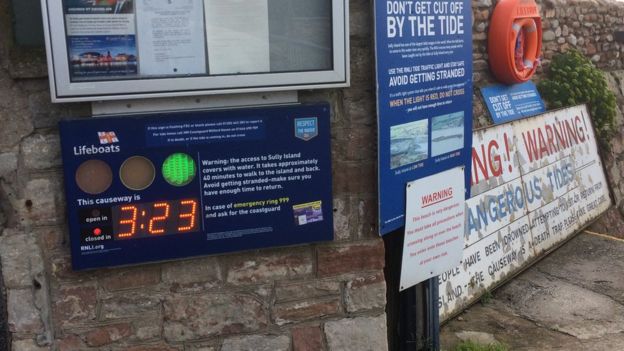
    (BBC news)

At the time, there was a suggestion that additional measures would be needed - audible warnings, perhaps, or text messages; this does not appear to have happened, although a new warning sign was put up earlier this year to supplement the pleasingly dramatic admonition below.
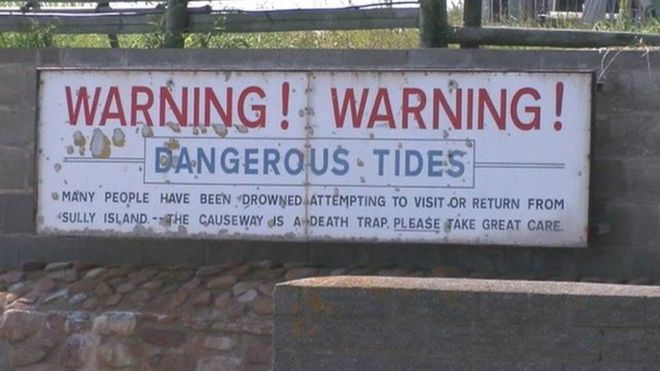

So, three years on, is the system working?
Thirty people have been rescued near Sully Island so far this year.
Well I'd say that's a resounding 'no' - either that or there are even more potential Darwin Award winners out there than I thought. The RNLI and coastguard clearly have their work cut out - and they're not the only ones:
Gordon Hadfield, who owns the beach at Swanbridge and a cafe, said he and his staff had saved six people from the water in the past four years. Three weeks ago he led a family of eight to safety.
So how do people manage to get themselves marooned or washed off the causeway with such depressing regularity? According to the coastguard service
"The sad fact is, a lot of people come down here and do not know the tide is going to come around them. They don't know it's an island, so there's a lot of education around that."
Now, here I have to hold my hands up and say I have never been there but a quick look at Google clearly shows that, at low tide, the island's crown of vegetation is surrounded on all sides by sea-washed sand and rock; you don't have to be a geographical genius to work out the implications - unless, of course, you have no understanding of the concept of tides.

Sadly for humanity (or fortunately for the gene pool, depending on your outlook), such ignorance appears to be far from uncommon, as a trawl through the pages of this blog will show. In addition - and possibly a significant factor at Sully Island - there are the latter-day Cnuts, who somehow believe themselves (and their hapless families) exempt from the laws of nature and regard a tide-lapped causeway as a challenge.

As we have seen on previous excursions to the Somerset coast, the Bristol Channel claims to have the second strongest tides in the world (though some Canadians and Australians might beg to differ). Add in a 40-minute round trip on a slippery rock causeway and a plentiful supply of tourists - either ignorant or foolhardy - and you have a recipe for disaster.

---------------------

Update: from the RNLI website: and still it goes on...
'We were called just after 8:15pm this evening, Sunday 27th August 2017 to attend reports of people in the water off Sully Island. 
When we arrived on scene the people who had been in the water had made it ashore but a further 4 people (3 adults, one child) required lifeboat assistance to return to the mainland.'


Sunday, 31 August 2014

Bells and Whistles

I think it is fair to say that Sully Island, off the south coast of Wales, is never going to be a hot tourist destination for the masses.

For those who like their landscapes unspoiled, however, this former smugglers' refuge boasts an Iron Age fort and a Victorian shipwreck as well as panoramic views out over the Bristol Channel.

There is, however, one small problem: the island stands at the end of a 400m rocky causeway, cut off by the tide for all but a few hours a day, a situation which, regular readers will not be surprised to learn, appears to be beyond the comprehension of some visitors.

Over Bank Holiday weekends in particular, the local Penarth lifeboat crew must barely get a chance to sit down to a nice cup of tea and a slice of bara brith.
“We are repeatedly called out to rescue people cut off on Sully Island, despite constant warnings about the dangers of the incoming tide"
In  bid to cut down the number of incidents - and enable the crews to get on with the rest of their lives - the RNLI installed a pilot scheme in mid-June using tide powered traffic lights:
The traffic lights will use a tide gauge and indicate when it is safe for people to cross, when time is running out and when it is unsafe to walk along the causeway.
The yellow phase provides a countdown on how much time is left on the causeway as a return trip takes about 40 minutes on foot.
So, over two months on, was the scheme a success?
AN RNLI text service warning visitors about safe crossing times could be introduced to the Sully Island causeway in a bid to stop visitors getting stranded on the island.
Er... that'd be a 'no', then.
A sound warning system, and another traffic lights warning system based on the island, are also being considered by the RNLI in an effort to cut the number of call-outs to the volunteer lifeboat crew.
In fact, the number of call-outs this summer appears to have been basically unchanged, with stranded walkers claiming not to have seen the lights - the suggestion that they might, of their own initiative, have ascertained the tide times beforehand doesn't appear to enter into it - although evidence elsewhere points to a minority who feel such warnings somehow do not apply to them.

So the RNLI are planning another set of lights on the island - somewhat to the detriment, one feels, of this scenic Site of Special Scientific Interest - and a sound warning, as well as sending tide times to anyone who texts them to ask.

And when that doesn't work, and Mr and Mrs Cnut and their little dog still end up marooned, what then?

One reassuringly certain thing about the tide is that it goes down again. By my calculations, it's never going to be more than about seven or eight hours until the causeway is passable again, and, if they were fit enough to undertake the 20-minute walk across the rocks, a night in the open isn't going to kill them.

The problem is that their stupidity just might:
“People are unaware off just how quickly the tide comes in and when they realise they are being cut off, they tend to panic and try to make it over the causeway to the mainland."
Which, given the depth of the channel and the fierce local currents, is a seriously bad idea. It's the perpetual problem faced by the RNLI; manpower and resources diverted from real emergencies into rescuing people from the consequences of their own foolhardiness or ignorance.

And it's horribly symptomatic of a society in which we are all subjected to ever more interference because some people cannot or will not accept responsibility for themselves.

Sunday, 18 November 2012

Martyrs to the causeway

Regular readers will remember that, last month, a total of eight vehicles were stranded on the causeway that links Mersea Island to the rest of Essex after trying to cross at high tide.

But if you thought the resulting publicity would deter any would-be Canutes from recreating the scenario with this month's spring tides, you obviously have rather too much faith in human intelligence:
The Mersea Coastguard team was on a routine patrol when it came across a Ford Fiesta partly submerged on the Strood on Friday.
And there's more...
The previous day a 4x4 and Toyota van were stuck on the causeway that links Colchester to Mersea Island and the police towed both vehicles to safety.
At least it was the police that time; the coastguard (and, on other occasions, the RNLI) have quite enough to do with keeping Darwin award hopefuls out of trouble on the water without having to sort out motorists as well.

It would be interesting to know something about these drivers who fail to grasp the significance of the terms 'tidal causeway' and, for that matter, 'island'. I doubt, somehow, that locals would get caught in this way (though I might be wrong).

A quick trawl through comments on the subject at the Gazette suggests that the Romford Navy may be well represented among the stranded motorists, which, as well as offering an agreeable sense of Schadenfreude, sounds quite plausible; anyone whose idea of fun is driving for 90 minutes up the A12 to blast around on a jest-ski is surely more likely than most to consider himself superior to the laws of nature.

Whoever they are, their persistence in the face of unprecedented tide table availability and local news coverage suggests that, despite the media storm that greeted his opinion last week, Professor Gerald Crabtree may have a point when he says that human intelligence is in decline because a lack of it is no longer fatal:
"the need for intelligence was reduced as we began to live in supportive societies that made up for lapses of judgment or failures of comprehension."


Saturday, 20 October 2012

The causeway here at Mersea is not drained...

Of all the people in a position to appreciate the number of Darwin award hopefuls in our midst, it is surely the RNLI who see the most.

Their call-out records describe a cornucopia of thwarted opportunities to depart this world as a result of carelessness, imprudence or downright idiocy, from the woman and her son floating far out to sea in rubber rings or the three men adrift in the English Channel in a child's toy dinghy to the would-be weekend yachtsmen bumbling about in the busiest shipping lane in Europe (for all these and more, see the label RNLI).

And if that were not enough, there are the occasions when they have to step in to rescue stranded motorists and pedestrians cut off by rising sea water; latter-day Cnuts for whom tide-tables are clearly a source of ineffable mystery.

This week's spring tides brought us spectacular news footage of waves overtopping harbour walls and lapping at the doors of coastal homes, but, in rural Essex, some rather more mundane dramas were unfolding:
A lifeboat manager has called for improved warning signs at an Essex causeway after 13 people had to be rescued at high tide within 24 hours.
The West Mersea Lifeboat rescued a woman, child and a baby on The Strood, towards Mersea Island, on Thursday and 10 people were caught out on Wednesday.
Like his Northumbrian counterpart, the local lifeboat operations manager is 'fed up' with calling his volunteers away from work or family to deal with the handful of motorists every year for whom the word 'island' is not sufficient clue that some care should be exercised en route at high tide in the absence of a bridge.

As events at Holy Island have shown, putting up bigger and better warning signs will still not deter the true Darwin Award hopeful who clearly thinks such things do not apply to him. The next half-wit to be fished out leads to a call for lights, and the next one, to barriers - how far do we have to go to protect people from their own stupidity?

You can almost sense the exasperation behind the latest press release:
"Essex Highways would like to remind users not to take unnecessary risks on The Strood and to use a common-sense approach when the water is at high tide."
Good luck with that one!


Update: More in the same vein...

Monday, 1 August 2011

The tide is high...

There's a horrible inevitability about it. Give homo not-so-sapiens a tidal causeway and a clear indication of when it's safe to cross and he will still end up being fished out by the rescue services.

Despite clear warning signs and tide indications, a Cumbrian couple had to be winched to safety by the RAF this week after trying to drive back from Holy Island an hour and a half after the safe crossing time had passed.

And it's only a fortnight since the Seahouses lifeboat was called out to the causeway for the eighth time this year; this time to rescue an Australian couple whose car was rapidly turning into a submarine. Their spokesman is probably getting fairly tired of having to comment:

Ian Clayton, from the Seahouses station said: "It's incredible that people seem to think they can drive their cars into the North Sea."

"A couple of years ago islanders specifically warned a man to leave the island before the tide came in, otherwise he would get stuck. He pooh-poohed it, saying it was just something to frighten tourists, but half an hour later he was hanging onto the roof of his car and his wife was up to her chest in water, clinging on to their two children."

The locals, meanwhile, are more outspoken on the subject:

Susan Massey, parish council chairman and owner of the island's Oasis cafe, said: "Anyone that gets stuck really has got to be an idiot as there are warning signs with tidal times all over the island. Barriers have been suggested in the past, but if a person wants to cross at stupid time then they will."

An average year sees around a dozen of these call-outs, as yet another visitor to the island thinks he - and it is usually a he - knows better than the locals. One can forgive the RNLI for getting a bit fed up; each lifeboat call-out costs the RNLI 'between £1,800 and £2,000', which equates to an awful lot of tin-rattling on a saturday morning.

So what prompts these latter-day Cnuts* to defy the tide? Perhaps it's a failure to grasp fully the implications of the word 'Island', or an inability to read or understand official notices, but I'm inclined to think that it has much to do with the nature of our society.

After all, as a trip along any British motorway will amply demonstrate, if you bombard a population with endless instructions and warning signs, sooner or later they will stop trying to distinguish between the necessary and the unnecessary and simply ignore them all.


*'Canute' was a rather twee attempt to anglicise the pronunciation of the original (and prevent ill-bred sniggers from the back of generations of classrooms); and of course, being rather more intelligent that these characters, he wasn't actually ordering the tide to retreat but making a point about the limitations of power.