Of all the animals of prey, man is the only sociable one.
Every one of us preys upon his neighbour, and yet we herd together.
The Beggar's Opera: John Gay

Showing posts with label RNLI. Show all posts

Wednesday, 30 August 2017

They that go down to the sea in blow-up flamingoes...

What is it about Rhyl and inflatables? Rhyl, as regular readers may remember, was where a mother-and-son duo aboard an inflatable rubber ring were fished out of the Irish Sea by the long-suffering RNLI a few years ago and every summer since has brought more examples of pneumatic foolhardiness.

The latest occurred last week, when lifeboats were called out to look for a child who had 'fallen from an inflatable flamingo' some 400m from the beach. According to witnesses, the deflated bird retrieved from the water during the search (the RNLI web page helpfully includes a picture) was originally part of a flotilla of giant blow-up toys which included a 'white flamingo' (or possibly a swan?), a unicorn and a slice of pizza.

While there is no shortage of parents who, having reproduced, appear to be attempting to remedy the fact by casting themselves and their progeny adrift on inflatable toys in in an offshore breeze - the prevailing winds at Rhyl head more or less straight out to sea - and an outgoing tide (the flamingo call-out came an hour and a half after high water), this motley collection surely qualifies for special mention (or possibly an Arts Council grant).

This story comes only a few weeks after reports that the Rhyl lifeboat crew, called out to a small inflatable dinghy in difficulties in an offshore wind, found something strangely familiar about the situation:
The two people in the vessel were immediately recognised as the same ones the crew had been called to on three previous occasions in the last month. 
Although the boat was equipped with an outboard motor, the engine lacked sufficient power to counteract the forces of wind and tide. One can imagine that it was through gritted teeth that the pair were subsequently 'given some strong advice' about basic seamanship; with that level of incompetence and carelessness out there, it must be only a matter of time before there simply aren't enough lifeboats and helicopters to go round.

Perhaps all this is an inevitable consequence of the ubiquitous health & safety culture pervading our schools and society as a whole. Remove the hazards from day-to-day living and the human race, in Gaia-esque self-regulation, is likely to discover for itself other ways of putting natural selection into practice for the good of the species.

Tuesday, 22 August 2017

'Warning! Warning!'

As I write this, there are two gas engineers busy digging a hole in the road outside the Tavern. One of them has just lit a cigarette so, if this post is never completed, you will know why...

Remember Sully Island?

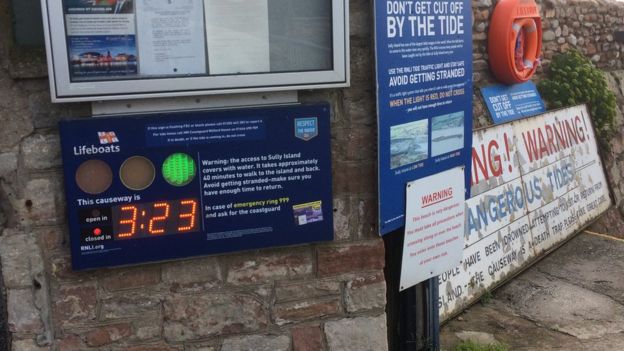
The 400m rocky causeway which connects this tiny outcrop to the coast of south Wales is completely covered by fast-flowing water twice a day. Back in 2014, the RNLI installed warning lights in a bid to reduce the number of visitors cut off by the rising tide.

    (BBC news)

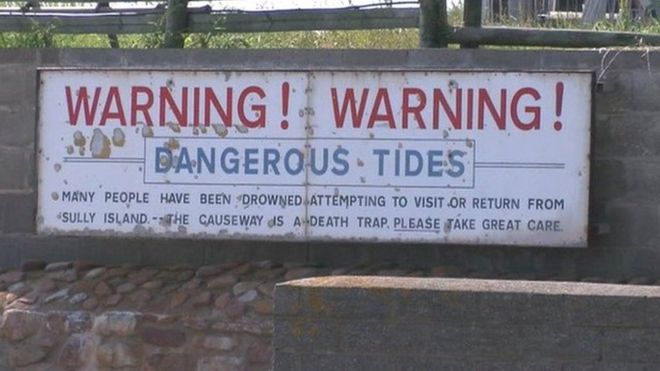
At the time, there was a suggestion that additional measures would be needed - audible warnings, perhaps, or text messages; this does not appear to have happened, although a new warning sign was put up earlier this year to supplement the pleasingly dramatic admonition below.


So, three years on, is the system working?
Thirty people have been rescued near Sully Island so far this year.
Well I'd say that's a resounding 'no' - either that or there are even more potential Darwin Award winners out there than I thought. The RNLI and coastguard clearly have their work cut out - and they're not the only ones:
Gordon Hadfield, who owns the beach at Swanbridge and a cafe, said he and his staff had saved six people from the water in the past four years. Three weeks ago he led a family of eight to safety.
So how do people manage to get themselves marooned or washed off the causeway with such depressing regularity? According to the coastguard service
"The sad fact is, a lot of people come down here and do not know the tide is going to come around them. They don't know it's an island, so there's a lot of education around that."
Now, here I have to hold my hands up and say I have never been there but a quick look at Google clearly shows that, at low tide, the island's crown of vegetation is surrounded on all sides by sea-washed sand and rock; you don't have to be a geographical genius to work out the implications - unless, of course, you have no understanding of the concept of tides.

Sadly for humanity (or fortunately for the gene pool, depending on your outlook), such ignorance appears to be far from uncommon, as a trawl through the pages of this blog will show. In addition - and possibly a significant factor at Sully Island - there are the latter-day Cnuts, who somehow believe themselves (and their hapless families) exempt from the laws of nature and regard a tide-lapped causeway as a challenge.

As we have seen on previous excursions to the Somerset coast, the Bristol Channel claims to have the second strongest tides in the world (though some Canadians and Australians might beg to differ). Add in a 40-minute round trip on a slippery rock causeway and a plentiful supply of tourists - either ignorant or foolhardy - and you have a recipe for disaster.

---------------------

Update: from the RNLI website: and still it goes on...
'We were called just after 8:15pm this evening, Sunday 27th August 2017 to attend reports of people in the water off Sully Island. 
When we arrived on scene the people who had been in the water had made it ashore but a further 4 people (3 adults, one child) required lifeboat assistance to return to the mainland.'


Tuesday, 14 July 2015

They that go down to the sea in blow-up dinghies (Part 2)

A matter of days after the RNLI fished out a couple of lads adrift with their beer cans in the Bristol Channel, another rescue took place off the Kent coast (apparently a favourite spot for maritime Darwin Award hopefuls, as a trawl through the Tavern archives shows).
A dad has told of the terrifying moment he and his family lost control of their dinghy and drifted out to sea.
In this case, the accidental seafarer was accompanied in the 6ft dinghy by his wife, their nine- and seven-year-old children and their seven-month old baby.
The Gillingham resident, who has asked not be named, said his intention was to “go back and forth” in the shallow water near the beach.
“Families all the time take a dinghy out and have a paddle with their children, we were just unfortunate."
Unfortunate, perhaps, in the fact that the engine failed - although they only bought the boat two days before and were unlikely to be familiar with its management - and the subsequent breaking of an oar, but to set out with a full load and (to judge by the photos) only two life jackets between them was surely unwise, to say the least, especially with an outgoing tide (easily checked online) and a steady offshore wind (according to the RNLI).
“The funny thing is that when the oar snapped, I could have jumped out and pulled the dinghy towards shore because we were so close; it’s hard to explain, but the panic just set in."
Instead, they called for help as they drifted a mile out to sea in worsening conditions - the accompanying video shows the craft riding hazardously low in choppy water - using the mobile phone they had with them. This last precaution absolves them, perhaps, of seeking full Darwin Award Hopeful status despite entrusting themselves and their progeny to a fragile and unfamiliar vessel.

Stung by social media criticism, the father contacted the local press to give details of the rescue, including a gratifyingly thorough tribute to the RNLI crew, and a statement that, somehow, has Zeitgeist written all over it:
“In hindsight, we definitely shouldn’t have done it, trust me the lesson has been learnt. But it was never our intention to go anymore than a matter of feet from the beach, events just took over."

Wednesday, 8 July 2015

They that go down to the sea in blow-up dinghies

As the coastal Darwin Award Hopeful season continues, we have the slightly baffling story of two would-be mariners picked up by the RNLI off the Somerset coast.

The lifeboat crew, scrambled from work when the Coastguard spotted the child-sized boat drifting a mile out to sea, arrived to find the leaking 5ft dinghy occupied by two full-grown men 'oblivious that they were out of control and at the mercy of the very strong tides'.

The intrepid amateur seafarers had been at sea for three hours already, having drastically underestimated the distance to their intended destination of Steep Holm, a rocky island five miles offshore in the Bristol Channel.

What they expected to do there is, it has to be said, something of a mystery:
It is a nature reserve and a Site of Special Scientific Interest famed for its beautiful May-flowering wild peony. It is home to the remains of a 12th century Augustinian priory.
While it also boasts the remnants of wartime military installations and a Victorian barracks (now a 'Visitor and Education/Exhibition Centre'), it is hard to see this plethora of aesthetic and intellectual stimulation appealing to the bare-chested duo - one sporting abundant tattoos and a back-to-front baseball cap - pictured in the RNLI report.

Even if I am wrong and their motives were of the loftiest, they chose an odd way to go about it. Regular day trips are on offer and, given that Steep Holm is 'in the middle of a busy shipping channel, isolated by brisk tidal currents and a difficult landing place', it takes a special sort of mindset to purchase a toy boat from a beach shop and set off merrily into the blue.

Sadly for the men and women of the RNLI, there's a lot of it about.


Update: The Mail has since got hold of the story - claiming in its inimitable style, that they were 'five miles out' and 'without a paddle', despite the oars clearly visible in the accompanying video and the article stating 'a mile'- and identified the pair:
Mr Hole - a tattoo artist - said: 'It was going well until we got a small puncture and the boat started slowly going flat. We were miles from where we set off. I'm not sure how we got the puncture, but I think it might have been off one of the beer cans cutting the inside.

Sunday, 19 April 2015

Cnuttery? There's an app for that...

With the onset of warmer weather around these shores, we are girding our metaphorical loins to document the usual quota of beach rescues.

Along with the foolhardy who either fail to appreciate the lunar influence on our seas or believe that the laws of physics apply only to other people, those calling upon the skills of the maritime rescue services can often include the hubristic unwary who think they can walk on water - or rather, water-saturated mud.

Those members of my family who grew up within spitting distance of the Sands of Dee were, to a man (and woman) reared on the poetic fate of Mary, who chose the wrong time to fetch the cattle home across the estuary and thereby met an untimely and soggy end; 'And never home came she...' Such cautionary tales have, for countless generations, been used to teach impressionable youngsters the dangers of coastal mud and a rising tide.

Now, however, with schools more likely to teach the exploits of Anansi the Spider (spelling amended - see below) or Rama and Sita than the sad story of Mary and her cows and with easy travel bringing droves of unwary landlubbers to the seaside, the rescue services have their work cut out.

This weekend brought a particularly up-to-date version of the problem, thanks to a mobile-phone based craze doubtless conceived by urban technophiles who don't see much of Mother Nature in the raw, so to speak:
The coastguard had to be called out after 15 people got stuck in mud while taking part in a hi-tech seaside treasure hunt.
Someone appears to have had the bright idea of hiding the 'treasure' near the low water mark during a spring tide on a stretch of coastline notorious for quicksand. According to the coastguard Operations Officer:
"We have since discovered that they were undertaking the hobby of geocaching. This was in an extremely dangerous place and we would not encourage others to search in these areas because there are complex tidal patterns and deep mud."
Geocaching is, as I understand it, running around with a GPS-enabled smartphone looking for clues; self-preservation, it seems, is optional. The impressive supporting cast called out out by concerned passers-by (and credited in full in the Telegraph) consisted of:
Clevedon Lifeboat, the coastguard helicopter from Portland, a search and rescue helicopter from RAF Chivenor, the Portishead RNLI inshore lifeboat, teams from the Weston-super-Mare and Portishead Coastguard Rescue and the Somerset Fire and Rescue Firefly Hovercraft.
Along with one for the ultimate selfie fail, it's probably about time they set up a special Darwin Award category for those who, abandoning all common sense, may blithely follow their own pocket-sized Pied Piper into oblivion.

Sunday, 31 August 2014

Bells and Whistles

I think it is fair to say that Sully Island, off the south coast of Wales, is never going to be a hot tourist destination for the masses.

For those who like their landscapes unspoiled, however, this former smugglers' refuge boasts an Iron Age fort and a Victorian shipwreck as well as panoramic views out over the Bristol Channel.

There is, however, one small problem: the island stands at the end of a 400m rocky causeway, cut off by the tide for all but a few hours a day, a situation which, regular readers will not be surprised to learn, appears to be beyond the comprehension of some visitors.

Over Bank Holiday weekends in particular, the local Penarth lifeboat crew must barely get a chance to sit down to a nice cup of tea and a slice of bara brith.
“We are repeatedly called out to rescue people cut off on Sully Island, despite constant warnings about the dangers of the incoming tide"
In  bid to cut down the number of incidents - and enable the crews to get on with the rest of their lives - the RNLI installed a pilot scheme in mid-June using tide powered traffic lights:
The traffic lights will use a tide gauge and indicate when it is safe for people to cross, when time is running out and when it is unsafe to walk along the causeway.
The yellow phase provides a countdown on how much time is left on the causeway as a return trip takes about 40 minutes on foot.
So, over two months on, was the scheme a success?
AN RNLI text service warning visitors about safe crossing times could be introduced to the Sully Island causeway in a bid to stop visitors getting stranded on the island.
Er... that'd be a 'no', then.
A sound warning system, and another traffic lights warning system based on the island, are also being considered by the RNLI in an effort to cut the number of call-outs to the volunteer lifeboat crew.
In fact, the number of call-outs this summer appears to have been basically unchanged, with stranded walkers claiming not to have seen the lights - the suggestion that they might, of their own initiative, have ascertained the tide times beforehand doesn't appear to enter into it - although evidence elsewhere points to a minority who feel such warnings somehow do not apply to them.

So the RNLI are planning another set of lights on the island - somewhat to the detriment, one feels, of this scenic Site of Special Scientific Interest - and a sound warning, as well as sending tide times to anyone who texts them to ask.

And when that doesn't work, and Mr and Mrs Cnut and their little dog still end up marooned, what then?

One reassuringly certain thing about the tide is that it goes down again. By my calculations, it's never going to be more than about seven or eight hours until the causeway is passable again, and, if they were fit enough to undertake the 20-minute walk across the rocks, a night in the open isn't going to kill them.

The problem is that their stupidity just might:
“People are unaware off just how quickly the tide comes in and when they realise they are being cut off, they tend to panic and try to make it over the causeway to the mainland."
Which, given the depth of the channel and the fierce local currents, is a seriously bad idea. It's the perpetual problem faced by the RNLI; manpower and resources diverted from real emergencies into rescuing people from the consequences of their own foolhardiness or ignorance.

And it's horribly symptomatic of a society in which we are all subjected to ever more interference because some people cannot or will not accept responsibility for themselves.

Thursday, 14 August 2014

'I must go down to the sea again, for the call of the running tide..

...is a wild call and a clear call that may not be denied.'

Well, we expected this week's unusually high tides to bring some interesting examples of Man (and Woman) failing to grasp the fact that the sea goes up and down and we certainly weren't disappointed.

Coastguard and RNLI reports show a predictable host of unwary day-trippers managing to get cut off in a variety of scenic shoreline locations but special mention must go to the woman stranded at the old breakwater in Lyme Regis with her six children, potentially making somewhat belated amends for having contributed so generously to the gene pool.

Also worth noting are the two cars which had to be extracted from the sea at Redcar yesterday. In one case, rather than wading to shore through a few inches of water, the occupants scrambled up to the roof of the vehicle and sat there in state like two latter-day King Cnuts.

Similar automotive woes awaited an unfortunate fisherman whose boat broke down off Dunbar. Finally rescued by the RNLI, he returned to the harbour to find his car under five feet of water (in the great tradition of local headlines, The East Lothian News gives us 'It's park and tide').

Forget the dour east-coast stereotypes, Dunbar's finest are clearly compassionate souls...
Gary Fairbairn, coxswain of Dunbar RNLI, said: “We didn’t have the heart to tell him about his car until we got back to land." 
...well, either that or they are veritable connoisseurs of Schadenfreude and wanted to savour the look on his face when he saw his submerged vehicle:
"To say he wasn’t happy is an understatement.
 There was less sympathy, however, in the comments:
'A full moon, highest tides, and he leaves it on the slipway to get in the way of other users? Sell yer boat son and stick to dry land.'
Meanwhile, we've become familiar with youngsters outsourcing their thinking to phones which, in some cases, appear to be smarter than their owners. There is certainly a growing tendency to rely on the things at the expense of common sense, as three holidaymakers from Essex found out when they set up a barbecue on a remote part of a Devon beach.

They had no idea of tide times, so it must have come as something of a shock to find themselves marooned on a fast-diminishing patch of sand at the foot of a sheer cliff. It was at that point that they realized - oh, the horror! - that they had no mobile signal to call for help.

Natural selection was thwarted by some distant observers calling out the rescue teams who airlifted them to safety, but even these Darwin Award hopefuls are presumably more of an asset to the gene pool than a group of teenagers from Norfolk.

With a high spring tide and a surge predicted, Hunstanton's Environment agency teams spent Tuesday night checking their flood defences. Patrolling the beach in the early hours of the morning, they found a cheerfully coloured tent pitched well below the expected high-water mark and containing five happily snoring teenage boys.

As anyone who has ever given houseroom to the species will know, teenage boys can sleep through alarm clocks, ringing phones or determined hoovering - almost anything, in fact, except the smell of frying bacon - so it's highly likely that without intervention, the youngsters would have been swamped inside their sleeping bags.

I hope their parents - and future progeny - are duly grateful.

Tuesday, 15 July 2014

All at sea

It is, alas, no surprise that the warm weather has, once more, brought the nautical Darwin Award hopefuls out in force . Exmouth RNLI, for example, were roused from their beauty sleep at 5am on Sunday when shouts for help were heard from the river:
A coastguard spokesman said: “The guy had been to the pub in the evening and decided to go kayaking in the middle of the night. 
“The tide was coming in and he was taken up the river which wasn't the direction he wanted to go. He capsized and the inshore lifeboat found him holding onto a moored boat at Pole Sands.”
A few hours later, the Exmouth crews were out again, this time delivering a stern lecture to one of those parents who, having already contributed to the gene pool, appear to be attempting to remedy the fact with the help of an inflatable toy,  an outgoing tide and an offshore wind.

And RNLI crews on the Tamar have quite enough on their hands without having to deal with the likes of the Plymouth man reported missing by his wife when he failed to return from a fishing trip by 10.30pm on Saturday night; emergency services finally traced his mobile phone to the restaurant where he was having dinner, though the news story sadly fails to say with whom.

Elsewhere, Man's (or, in this case, Woman's) battle against the tide has claimed yet another automotive victim; since it's clear that individual responsibility is never going to be enough, perhaps the authorities at Brean Beach car park should look into some way to alert motorists to the rising waters.

A few pence on the cost of parking could, with a bit of imagination, furnish a brightly-coloured paper wristband stamped with that day's 'leave-by' time, though personally I rather like the idea of firing a cannon from the nearby fort as the water approaches.

After all, if people need to be protected from the consequences of their own lack of forethought, the rest of us ought to be able to get some fun out of it where we can.

Sunday, 5 January 2014

A fatal attraction

'...behind all, is spread as a curtain the eternal sea, ever the same and ever changing. Yet I love to see it best when it is lashed to madness in the autumn gale, and to hear the grinding roar and churn of the pebbles like a great organ playing all the night. 
'Tis then I turn in bed and thank God, more from the heart, perhaps, than, any other living man, that I am not fighting for my life on Moonfleet Beach.'
No-one reading John Meade Falkner's classic novel could have any doubt that the sea can be lethal not just to mariners but to those struggling with storm waves onshore.

The media coverage and Christmas break have conspired to send an unprecedented number of storm-watchers and thrill-seekers out to cause anxiety - and extra work - to those responsible for public safety around Britain's coast and, for some, the results have been fatal.

Some years ago, I attended the funeral of an ex-sailor with decades of experience of the sea. He was swept off rocks by a freak wave only a few miles from where the now-notorious parents took their small children onto the harbour wall; even those familiar with the risks can be caught out.

When the hymn 'Eternal Father, strong to save' began, the congregation stood but the hymn-books remained closed. Everyone there knew by heart the words of that heartfelt plea on behalf of 'those in peril on the sea' - a telling indication of how coastal communities view the risk with which they live and, sadly, of the number of sea-related memorial services the church has seen.

These same communities provide the volunteers who crew the lifeboats; they know better than anyone the potential danger of rough seas along the coastline and yet are prepared to go out in appalling conditions to save lives.

By contrast, even allowing for over-dramatic journalistic commentary, it appears that those putting themselves in harm's way for the thrill of a soaking or a memorable photograph must have little idea of the destructive power of waves or water-borne debris.

I've written elsewhere in a more light-hearted vein on popular ignorance of the sea, but, this week at least, it's no joking matter. There is a natural attraction in the spectacle of in waves 'lashed to madness' but, unless appreciation is tempered with respect and common sense, it is likely to go on luring the unwary to their deaths.

Monday, 30 December 2013

Toast of the week - a Herculean task

In the previous post, I mentioned a man dressed as Santa Claus on behalf of a Canvey Island charity, whose sleigh was undeservedly run out of town at the behest of some over-zealous citizens (JuliaM has the story too).

He is, in fact, the chairman and founder of the charity 'The Friends of Concord Beach', an organisation formed with the laudable aims of maintaining the salt-water pool there and promoting 'good citizenship, civic responsibility and good habits' in those visiting the area and using the facilities.

The group are also busy arranging for sponsored benches along the front and a pool-side shower, together with murals to cover unsightly graffiti and some very polite notices:


But it doesn't stop there; these valiant souls have a far more challenging objective in their sights:
To promote the education of those who visit the beach in sea water and beach safety as it applies to the tidal estuary of the River Thames.
One has to admire their ambition; as a trawl through the Tavern archives makes abundantly clear, Britain's coastline is the destination of choice for an alarming number of Darwin Award hopefuls every year. In fact, an appropriately seasonal example was reported this week:
Two men who were in a toy inflatable boat and wearing penguin and Santa costumes have been taken to a Cornish harbour by the RNLI after they were seen drifting out to sea.
These intrepid mariners set out to paddle across Mount's Bay from Marazion to Penzance, a distance of about 4km, in voluminous fancy dress and without the benefit of life-jackets or a seaworthy craft; what a good thing we've been having such calm weather recently!

If the Friends of Concord Beach seriously intend to tackle the Augean stables of public ignorance of even the basics of beach safety, they certainly have their work cut out, which is why we are raising a glass to them and their endeavours.

Friends of Concord Beach, your very good health!

Friday, 16 August 2013

Toast of the week - animal rescue edition

It's not just humans who get cut off by the tide, you know...
Two young ferrets who were at risk of drowning were rescued by lifeboat volunteers at Newbiggin RNLI lifeboat station.
What makes this story particularly appealing - apart from its furry protagonists - is the tone of the RNLI account of the incident, written by the local volunteer Press Officer, who has eschewed the usual utilitarian style of reporting in favour of a more literary approach:
The ferrets' anxious owners had made desperate attempts to save their animals by wading into the sea on the Cambois Bay rocks but their best endeavours looked likely to be scuppered when neither Tootsie or Lucky responded.

The crew found Tootsie and Lucky minutes away from drowning by the rapidly rising tide.
Fortunately the intrepid rescuers were able to calm the animals (and, by the sound of it, their distraught owners) and lift them to safety from the rocks.

The icing on the cake is the accompanying photograph, taken by the author; showing two seemingly identical ferrets, it is carefully labelled 'Tootsie (left) and Lucky' - a level of attention to detail that some of our national newspapers would do well to emulate.

It may come as no surprise that the Press Officer, who has written a book about the lifeboat station, is also listed as their mechanic; it's surely good news for the crews and those who may need rescuing that the lifeboats are in such meticulous hands.

When every day seems to bring us another news report of man's inhumanity (or indifference) to man, it is reassuring to think there are still volunteers out there prepared to risk life and limb if necessary to save lives - and to rescue the occasional pet.

It's a while since we had a toast in the Tavern, so I invite you to raise a glass tonight to the men and women of the RNLI and to their Press Officer in Newbiggin by the sea.

Wednesday, 10 July 2013

The heavin' seas of Rye

By way of a coda to Monday's post:
The volunteer lifeboat crew at Rye Harbour RNLI Lifeboat Station were kept busy as the heatwave hit Rye Bay at the weekend.
During the course of the day, there were two changes of crew and 17 incidents attended in total, including searching for nine missing children and more than 10 inflatables.
All the children were subsequently found safe on dry land (a useful tip, by the way; if children wander, they usually keep their backs to the sun so that's always the first direction to try). You'd have thought, though, that given the large number of people there, parents would have been ultra-vigilant:
At 12.30pm there were more than 25,000 people on Camber Sands with still more people arriving. 
Sounds awful! Somehow, I'm irresistibly reminded of this:
'Now that all the seals and their wives were on the land, you could hear their clamour miles out to sea above the loudest gales. At the lowest counting there were over a million seals on the beach – old seals, mother seals, tiny babies and holluschickie, fighting, scuffling, bleating, crawling, and playing together – going down to the sea and coming up from it in gangs and regiments, lying over every foot of ground as far as the eye could reach...'
Rudyard Kipling: 'The White Seal' from 'The Jungle Book' (if you thought it was all singing bears and dancing monkeys, do take a look!)
We've described elsewhere how infant reins seem to have vanished from popular culture in recent years and free-range toddlers are common in our town centres and shopping malls, so perhaps it's natural that today's children are in the habit of wandering off.

But what is it about the good folk of Sussex that such a large number of them fail to keep count of their offspring in such a crowd or, alternatively, set them adrift in a strong wind?

Monday, 8 July 2013

Heads of oak

With the hot weather suddenly upon us, the national Darwin Award season is in full swing around the coastline of this once-proud maritime nation.

Along with some more unusual incidents featuring a flock of kite surfers and an injured base-jumper, this weekend has seen a particularly spectacular haul of run-of-the-mill incompetence and foolhardiness. In Essex, for instance, the Darwin hopefuls were clearly out in force:
The volunteer crew of Southend RNLI Lifeboat Station were kept busy over the weekend, launching to people drifting on inflatables, youths jumping into the sea from a jetty, a broken down speedboat, and reports of a missing woman.
Meanwhile, there was a classic trio of incidents further north in Redcar, where the unaccustomed sunshine had obviously gone to their heads. The first involved that perennial favourite of thrill-seeking Darwin Award hopefuls and, in more southerly waters, the preferred vessel of the Romford Navy, the jetski.

Since these are essentially noisy aquatic motorbikes expressly designed to be driven around at high speed just off crowded beaches annoying the hell out of everyone, a capsize is likely to be greeted with cheers of Schadenfreude, especially when it involves several people:
The personal water craft capsized while towing an inflatable ring, throwing all three riders into the sea and leaving the fourth person stranded on the inflatable. A strong offshore wind was blowing all four people quickly out to sea.
Someone called the local lifeboat crew, who fished out the stranded mariners, restarted the jetski and generally set all to rights, pointing out to the clueless quartet the benefits of donning a lifejacket before travelling at speed on deep water.

At teatime, the lifeboats were called out again, this time to one of that special category of Darwin hopefuls who, having reproduced, try to amend the fact by merrily casting their own progeny adrift in an inflatable toy boat on a windy day.

There's a lot of it about, from the southern coast right up to the waters off Western Scotland, where Weekend Yachtsman, commenting on another post, describes repeated coastguard alerts of the kind. This case, however, offers an interesting variation on the usual theme:
An adult who had been in the dinghy had apparently jumped into the sea to assist a second child who was in the sea. This then caused the child in the dinghy to drift further out to sea on an offshore wind. 
Fortunately for the family, if not the gene pool, the young castaway was retrieved by a member of the public, but since this good Samaritan seized the child and left the inflatable to pursue its course on the outgoing tide, the lifeboat still had to hunt it down to avoid false alarms.

Given the weather, it would be easy to blame all this on the sort of people whose only previous aquatic experience had been heavily chlorinated, but the third rescue, the following day, involved a local who should have known better:
Two men became trapped by the incoming tide at cliffs near Saltburn on Sunday 7 July 2013. The alarm was raised just after 2pm after two men, one from Middlesbrough and the other from Saltburn, were trapped by the tide at a location known locally as Penny Hole.
There is a noticeable air of resignation in the RNLI report; you can almost hear the weary sigh:
‘With the weather the way it has been for the past few days, and with the high tide being around tea-time, we could have almost predicted we’d get a call to rescue someone at Huntcliff.
The sole benefit to be derived from these antics is that they give volunteer crews useful practice in life-saving skills, though it would surely be a very good thing if those rescued from self-inflicted peril acknowledged the service by supporting the RNLI in the future.

It will certainly be needed: all the news coverage carries the usual admonitions on the subject of tethering inflatables, wearing lifejackets and checking tide times but only an insane optimist would expect it to make any difference.

Tuesday, 28 May 2013

Toast of the week - pragmatic Darwinism

As ever, the bank holiday weekend sees the start of the coastal Darwin Award season, as landlubbers seek ever more ingenious ways of removing themselves from the gene pool only to be thwarted by the tireless efforts of the Coastguard and the RNLI.

Early aspirants include the two intrepid anglers blown out to sea from Humberside in a child's toy dinghy, together with the usual assortment of clueless jetskiers and overconfident swimmers, 130 of whom had to be fished out of the North Sea when organisers launched a two-mile open-water race in unseasonably cold water and a current so fast the hapless swimmers were travelling backwards.

And, of course, there are always the latter-day Cnuts, who have apparently failed to grasp the essential fact that the sea level around our coasts goes up and down twice a day.

An elderly couple had to be rescued by the rather nifty Hunstanton Hovercraft (if you ever wondered what the RNLI buy with donations, check it out) when their 4x4 was stranded in a foot or so of water, but this is small beer compared to the experience of taxi driver Kryxdztof Tomaszek (H/T JuliaM, via comments).

The unfortunate Mr Tomaszek parked on Brean Beach (complete with pay-and-display ticket) and set off for a pleasant Sunday evening stroll along the sands, blissfully unaware that the car park was of a somewhat impermanent nature and there was a spring tide on the way.
'I managed to get in and tried to drive it away but the engine kept cutting out and two guys helped me out of the car by opening the driver's door and getting some belongings out.'
Despite the Mail's valiant attempts to create a life-or-death drama, there appears to have been little risk to life and limb; not really Darwin territory at all. It could, however, have been a very different story in Dorset, where teenagers have been seen climbing on the precarious piles of rubble that recently fell from the cliffs near Durdle Door.

A local resident reports that boys were clambering about high up on the stones, ignoring the fact that the rocks they dislodged were falling onto people below:
"Their reply was they are not throwing them so it's not their fault."
That sort of attitude has come to be associated with 'vulnerable' youngsters who need to be protected from themselves, so you might imagine that the Nanny State would have swung into action, ensuring everything is expensively fenced off. But no, they make 'em tougher than that in Dorset:
A spokeswoman for Portland Coastguard said the advice to people was not to climb on the rock, to act sensibly and to stay away from the landslip debris. 
"That's our advice, if they ignore it that's up to them," she added.
Well said: Madam, your very good health!

Friday, 30 November 2012

Sea-level of ignorance

Here at the Tavern, we have a great deal of respect for the men and women of the RNLI, ready to drop everything at a moment's notice and risk their lives on behalf of those in peril on the sea.

Some shouts, however, are less critical than others...
Staff from a Sea Life aquarium had to be rescued from the sea after they were stranded by an incoming tide.
Oh dear! Though you have to admit that it is rather funny...
The group of four from Southend Sea Life Adventure Aquarium were out near the town's pier head taking samples when they were cut off on Thursday.
....actually, it's very funny....
They ended up knee-deep in water and were unable to get back to shore.
...Stop! It's too much!
A volunteer Hovercraft crew from the Southend RNLI brought them back to shore and gave them safety advice.
*wipes tears from eyes*

Unbelievable! Though the RNLI do seem to be spending a disproportionate amount of their time rescuing latter-day Cnuts from the incoming waves, you'd have thought these people, at least, might have some inkling that the tide goes in and out.

According to the Sea-Life Centre's website:
'We like to call this Edu-tainment because we can guarantee that not only will you find the themed displays entertaining but we are sure you will go away knowing something new about the life that lives in our planet’s seas and oceans.'
Just don't expect them to know anything about the sea itself.

Full fathom five thy father lies;
Of his bones are coral made;
Overtaken by the tide;
As out from Southend he did wade.
Past the pier we watched them range,
Their lack of knowledge passing strange
That with the hours the tide would swell:
What's this?
The water's rising - bloody hell!


Saturday, 20 October 2012

The causeway here at Mersea is not drained...

Of all the people in a position to appreciate the number of Darwin award hopefuls in our midst, it is surely the RNLI who see the most.

Their call-out records describe a cornucopia of thwarted opportunities to depart this world as a result of carelessness, imprudence or downright idiocy, from the woman and her son floating far out to sea in rubber rings or the three men adrift in the English Channel in a child's toy dinghy to the would-be weekend yachtsmen bumbling about in the busiest shipping lane in Europe (for all these and more, see the label RNLI).

And if that were not enough, there are the occasions when they have to step in to rescue stranded motorists and pedestrians cut off by rising sea water; latter-day Cnuts for whom tide-tables are clearly a source of ineffable mystery.

This week's spring tides brought us spectacular news footage of waves overtopping harbour walls and lapping at the doors of coastal homes, but, in rural Essex, some rather more mundane dramas were unfolding:
A lifeboat manager has called for improved warning signs at an Essex causeway after 13 people had to be rescued at high tide within 24 hours.
The West Mersea Lifeboat rescued a woman, child and a baby on The Strood, towards Mersea Island, on Thursday and 10 people were caught out on Wednesday.
Like his Northumbrian counterpart, the local lifeboat operations manager is 'fed up' with calling his volunteers away from work or family to deal with the handful of motorists every year for whom the word 'island' is not sufficient clue that some care should be exercised en route at high tide in the absence of a bridge.

As events at Holy Island have shown, putting up bigger and better warning signs will still not deter the true Darwin Award hopeful who clearly thinks such things do not apply to him. The next half-wit to be fished out leads to a call for lights, and the next one, to barriers - how far do we have to go to protect people from their own stupidity?

You can almost sense the exasperation behind the latest press release:
"Essex Highways would like to remind users not to take unnecessary risks on The Strood and to use a common-sense approach when the water is at high tide."
Good luck with that one!


Update: More in the same vein...

Tuesday, 25 October 2011

Rhyl-life drama

Is there, I wonder, a category in the Darwin awards for those who, having reproduced, attempt to rectify the situation by removing theselves and their adult offspring from the gene pool in a startlingly novel and unintelligent way?

If so, honourable mention is surely due to the woman who, accompanied by her 15-year-old son, was picked up drifting off the coast of Rhyl this morning. It takes a truly spectacular lack of common sense to take to the sea in an inflatable ring in late October with an offshore breeze and an outgoing tide.

The RNLI are no strangers to the idiocy of their fellow-man (and woman) over bank holidays and Summer weekends, but they might have thought that by now, with the sea at 11 degrees and the air about the same, they could forget about the terminally incompetent and concentrate on rescuing the victims of genuine emergencies.

Anyway, all this started me wondering whether the RNLI have some sort of award system of their own for this kind of thing - after all, they probably see more of it than anyone else (with the possible exception of staff in A&E). You'll find some of the sort of thing I mean here under the label RNLI or sea rescue.

If they do, I'm sure it is kept under wraps - bad publicity and all that - but I'd like to think that, despite the serious nature of the risks involved, they do see a certain black humour in it all.

Sunday, 4 September 2011

Bobbing about in the beautiful briny sea

It hasn't been a good week for sponsored swims.

Last week, Pavlov's Cat highlighted the irony of rescuers being called out to assist 80 swimmers swept out to sea while racing to raise money for the RNLI; this week we have what may be one of the worst-organised mass fund-raising events ever.

Three lifeboats, a helicopter and a coastguard team spent several hours today searching for nine swimmers reported missing after the Pier to Pier swim from Bournemouth to Boscombe, an event which attracts some 1,000 participants.

It gradually emerged that eight of the swimmers had definitely gone home, blissfully unaware of the efforts being made on their behalf, and that the partner of the ninth was accounted for and had left - presumably with her; it's hard to imagine he would be callous enough to set off happily while she was bobbing around in the English Channel.

The organisers had insisted all along that the lost swimmers had simply departed for home since all the baggage had gone but the emergency services can't rely on that kind of assumption (which is reassuring for anyone who may find themselves genuinely at risk in Britain's coastal waters). One imagines that the relationship between the two is now somewhat strained.

After all, the RNLI and Coastguard have enough to do especially at weekends, what with rescuing Darwin Award hopefuls from unsuitable dinghies or complete ignorance of the existence of currents or tides.

Despite the straitened times, there seems to be no shortage of fund-raising events that focus on the experience - Go skydiving for cancer! Climb Kilimanjaro to save the whale! - rather than on the recipient cause; at its worst, the cost of the experience dwarfs the actual sum raised. Whatever the case, it is not unreasonable to assume that the organisers have devised a fail-safe method of ensuring everyone is accounted for.

I don't envy the representative of the British Heart Foundation who had to explain to the RNLI that their volunteer crews wasted an afternoon looking for a bunch of people who were happily tucking into tea and cakes at home.

Monday, 1 August 2011

The tide is high...

There's a horrible inevitability about it. Give homo not-so-sapiens a tidal causeway and a clear indication of when it's safe to cross and he will still end up being fished out by the rescue services.

Despite clear warning signs and tide indications, a Cumbrian couple had to be winched to safety by the RAF this week after trying to drive back from Holy Island an hour and a half after the safe crossing time had passed.

And it's only a fortnight since the Seahouses lifeboat was called out to the causeway for the eighth time this year; this time to rescue an Australian couple whose car was rapidly turning into a submarine. Their spokesman is probably getting fairly tired of having to comment:

Ian Clayton, from the Seahouses station said: "It's incredible that people seem to think they can drive their cars into the North Sea."

"A couple of years ago islanders specifically warned a man to leave the island before the tide came in, otherwise he would get stuck. He pooh-poohed it, saying it was just something to frighten tourists, but half an hour later he was hanging onto the roof of his car and his wife was up to her chest in water, clinging on to their two children."

The locals, meanwhile, are more outspoken on the subject:

Susan Massey, parish council chairman and owner of the island's Oasis cafe, said: "Anyone that gets stuck really has got to be an idiot as there are warning signs with tidal times all over the island. Barriers have been suggested in the past, but if a person wants to cross at stupid time then they will."

An average year sees around a dozen of these call-outs, as yet another visitor to the island thinks he - and it is usually a he - knows better than the locals. One can forgive the RNLI for getting a bit fed up; each lifeboat call-out costs the RNLI 'between £1,800 and £2,000', which equates to an awful lot of tin-rattling on a saturday morning.

So what prompts these latter-day Cnuts* to defy the tide? Perhaps it's a failure to grasp fully the implications of the word 'Island', or an inability to read or understand official notices, but I'm inclined to think that it has much to do with the nature of our society.

After all, as a trip along any British motorway will amply demonstrate, if you bombard a population with endless instructions and warning signs, sooner or later they will stop trying to distinguish between the necessary and the unnecessary and simply ignore them all.


*'Canute' was a rather twee attempt to anglicise the pronunciation of the original (and prevent ill-bred sniggers from the back of generations of classrooms); and of course, being rather more intelligent that these characters, he wasn't actually ordering the tide to retreat but making a point about the limitations of power.

Tuesday, 3 May 2011

And there goes another one!

What are the chances of that? Just as I was putting the finishing touches to last night's post, the Maritime and Coastguard agency were putting out another press release.

Yet again, three men in an blow-up apology for a boat had been rescued by the RNLI from being swept out to sea. So why is it always three?

There must be some question of critical mass. Two men alone would probably not do anything quite so conspicuously silly as climb into a child's inflatable toy and head out to sea, and four would be too many and too much trouble.

With three, there is also the question of the casting vote - even if one of them thinks it's not such a good idea, there are two left to overrule him.

And so Wynken, Blynken and Nod embark with their carrier bag of booze and their unsuitable clothing and, a few hours later, the lifeboat gets called out yet again.