Of all the animals of prey, man is the only sociable one.
Every one of us preys upon his neighbour, and yet we herd together.
The Beggar's Opera: John Gay

Friday, 13 June 2014

World Cup ruminations

Remember this from 2010?
"Worried about your waistline while you watch the football? Concerned you might be piling on extra pounds as the tension mounts? Fear not, help is at hand!"
Now once again, spurred on by the 'obesity crisis', Nanny has girded her formidable loins and issued stern warnings to those of you intending to spend the next few weeks wallowing on the sofa in a calorie-induced stupor.

This time her organ of choice is not the Food Standards Agency - they are busy nagging us about the dangers of raw meat - but the spuriously-named NHS Choices website which has helpfully published its 'World Cup 2014 Healthy Snacking Tips'.

The advice is much the same as last time, starting from the interesting premise that British audiences are incapable of watching a televised sporting event without some form of hand-held sustenance.
While you are glued to the TV for a few weeks following the fortunes of Hodgson's men, here are 10 healthy snacking tips to make sure your diet stays match fit.
All the usual hair-shirt suspects are there - oven-baked low-salt crisps, reduced-fat humus and unsalted peanuts, along with some new additions like air-popped popcorn (no sugar, butter or salt, of course) and fat-free yoghurt.

It all rather begs the question of who is the target audience, since NHS Choices is largely preaching to the converted and the worried well. Those who trawl its pages are surely in search of medical advice -the site's valid raison d'être - rather than a condescending lecture on 'Living Well' - unless, of course, they are fully paid-up Puritans seeking tangible approval for their ascetic lifestyle.

Even the most optimistic healthy-eating evangelist could hardly expect that, having discovered the page by accident or design, readers who have eagerly stocked up on beer and Pringles will experience a Damascene conversion and rush out to buy rice cakes and low-fat humus instead.

What is really galling about this is that someone was presumably paid to write this patronising drivel - if write is the correct word to apply to a piece in which 'snack' is used as a verb. It's something to bear in mind next time you hear about reduced NHS spending leading to cutbacks in patient care.

Saturday, 7 June 2014

He shoots, he scores!

Once again, the World Cup is upon us, a phenomenon easily recognized by ubiquitous England flags, a plethora of pointless memorabilia and an alarming tendency on the part of devotees to talk in meaningless cliches.

Meanwhile, every commercial enterprise which can squeeze in some connection, however tenuous, is making use of World Cup fever to bring in the punters. Thus Hatton Country World decided this week to anticipate England's first fixture with a match between two opposing teams of guinea pigs.

The idea, apparently, was to predict the result using animals; this is always a crowd-pleaser during the football tournament and guaranteed to draw the visitors. The ancient Romans, of course, had much the same idea, only with more entrails.

Twenty-two of the little animals were selected for the England-Italy match, dressed in tiny team strip and given a ball full of grass to play with. (The final score, for anyone who may unaccountably be interested, was England 0 - Italy 1.)

However, much as often happens in the human game, events on the pitch have been overshadowed by the headline-grabbing priapic antics of one of the squad.

To the surprise of staff, some of their carefully-segregated females were recently discovered to be pregnant. Further research revealed that a lone male had somehow found his way into their pen, where he clearly made the most of the opportunities on offer:
"We don’t know how long Randy was in the female enclosure but it could have been several weeks which would have given him time to go round the entire female population."
The park, according to reports, is currently home to around 300 guinea pigs housed in an assortment of anthropomorphic settings to entertain youngsters, though one might have thought that, after the first hundred or so, guinea pig fatigue must surely set in for even the most obsessive child.

Now, thanks to Randy's contribution of up to 100 potential pregnancies (outstripping - one hopes - even Tyneside bus-stop Lothario Keith MacDonald), the population looks set to double over the next few months.
Staff are now looking to build an extension to the guinea pig farm to accommodate Randy’s huge brood.
Hence all the media publicity, presumably; it will surely take a fair few entrance fees to house and feed them all.

Unless, of course, the management have other plans. From Wikipedia:
Guinea pig meat is high in protein and low in fat and cholesterol, and is described as being similar to rabbit and the dark meat of chicken.

Wednesday, 4 June 2014

Double your money

Looking for a new investment opportunity in a growth industry?

How about this one, endorsed by no less than an associate professor at the University of St Andrews School of Business Management?
“It's a brilliant business model because it creates its own demand.”
And what is this sure-fire success story? Those cynics still in possession of all their marbles* may not be surprised to learn that he's talking about tattoo parlours which offer a removal service as well.

We've commented here before on the rise of the tattooist on Britain's high streets; now, with the advent of mass-produced laser tattoo removal equipment, you can now pay someone £100 to ink Miley Cyrus onto your left buttock, then pay the same person ten times that amount to erase it when the embarrassment gets too much (although, by all accounts, you won't be able to sit down for a week afterwards).

The future pain, however, is irrelevant; in much the same way that the advent of the gastric band appears, for some at least, to be a licence to overeat in the certainty that a perceived quick fix is available should they require it, laser tattoo removal offers the possibility of indulgence today and redemption tomorrow, possibly even at public expense.

This, presumably, is why we are seeing headlines like 'What is tattoo roulette? Fearne and McBusted lay down the rules'. Who Fearne and McBusted may be I neither know nor care, but 'celebrities' drawing lots to decide which one of them gets a silly tattoo is an idea with Zeitgeist written all over it and will doubtless be emulated in bars up and down the land.

As fashions change, all those oh-so-trendy early 21st-century doodles are going to start looking decidedly out-of date and inevitably, as time (and gravity) takes its toll, that deliciously ironic My Little Pony peeping coyly over your waistband will begin to resemble a leering elderly cart horse in drag.

If you can get rid of it, you probably will, which is why tattooists everywhere are investing heavily in expensive removal equipment. With surveys suggesting that 17% of people with tattoos subsequently regret them, there's going to be plenty of work out there.

While an average-sized tattoo will set you back around £50-£150, removing it may well run into the thousands. It's a win-win situation; studios can happily cater for the most egregious whims of their clients secure in the knowledge that every tattoo today is a potential goldmine ten years hence.

 *a story handled with efficiency and style in Bucko's post and the attached comments


UPDATE: While we're on the subject, from today's Metro:
A woman who set up ‘the world’s first tattoo parlour for children’ was surprised to receive genuine enquiries from parents keen to ink up their kids.
Sadie Hennessy created the thought-provoking art project by placing an ad outside a high street shop in Whitstable, Kent. Her aim was to incite discussion about the sexualisation of children, but the controversial ‘business’ actually had ten genuine requests.

Tuesday, 3 June 2014

Flying tonight

Another asteroid, another drink!

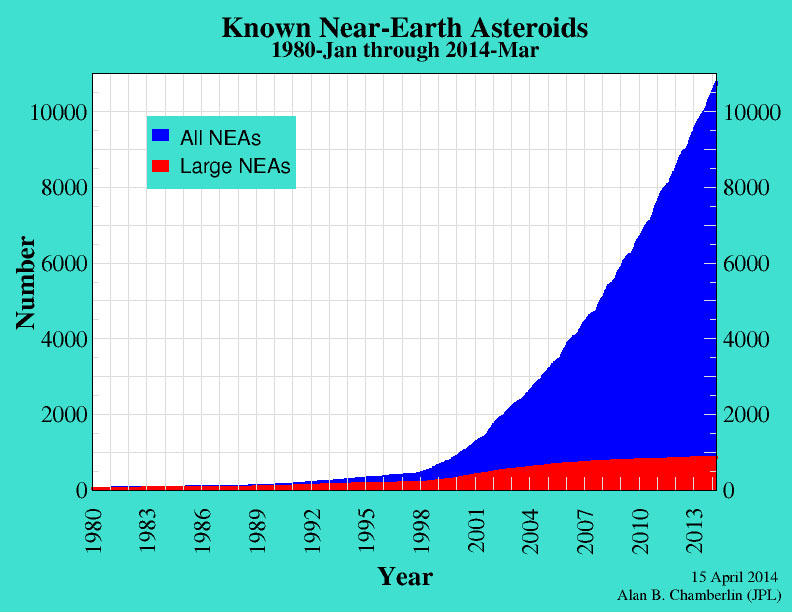
When we began the practice of raising a glass to every near-Earth asteroid five years ago, we didn't realise quite what we were letting ourselves in for. This chart gives some idea of what we're up against, even given the fact we don't usually pop the cork for anything over 1.5 million km away.

(There's lots more discovery data at the source: NASA/JPL)

According to Universe Today,
As of May 30, 2014, 11,107 near-Earth objects have been discovered with 860 having a diameter of 1 km or larger. 1,481 of them have been further classified as potentially hazardous.
To earn the designation of 'potentially hazardous', they need to approach within 7.48 million km and be at least 150m across; the sort of thing that would make a very nasty mess indeed should one ever turn up here. While every asteroid catalogued is one less unknown, there's something unsettling in the idea that we have only had a few days notice for most of the recent near misses.

While optimists talk of untold riches mining asteroids and plans are afoot to capture one and park it somewhere convenient, we should not forget the words of NASA's chief when asked what we could do if an asteroid were discovered to be heading straight for us: "If it's coming in three weeks, pray."

Anyway, if you're at a loose end with a glass in hand at 9pm (BST) tonight, the virtual telescope will be covering the flyby of the newly discovered 22-metre-wide 2014 KH39, which will be whizzing past 432,000 km above our heads at a decidedly nippy 25,000mph.

Bottoms up!

Saturday, 31 May 2014

Quote of the week - small town life

In the great tradition of local newspapers reporting non-events, this story hit the headlines last week:
Naked woman photo call shocks onlookers at Banbury’s Fine Lady statue
At around noon a woman was spotted sitting next to a man with a camera by Banbury’s iconic statue when she suddenly removed her summer dress and stood naked as the photographer took a series of snaps.
The statue is something of a red herring here; a quick glance at the handy, if blurred, accompanying photo - her companion was evidently not the only one taking pictures - shows the photographer sitting with his back to the equestrian artwork to capture his subject against the scenic backdrop of a main road.

There is something endearingly 'let's-put-the-show-on-right-here-in-the-barn' about the whole thing, from her utilitarian footwear to the choice of location - though that didn't stop a concerned citizen reporting them to Thames Valley Police (who must have been delighted at this addition to their workload).

According to an eye-witness who saw it from his office window, it "lasted probably about three minutes" - during which he clearly wasn't getting any work done - before, as he put it,
"She put her dress back on then went up near the dentists and did it again. Just another day in Banbury!"

(Fans of Giles cartoons may appreciate this one from 1970 on a similar subject (the zoom feature might be helpful))

Wednesday, 28 May 2014

Back again!

So... I've opened the shutters and removed the worst of the dust in Tavern following a short absence; did anything important happen while I was away?

Certainly the election seems to have produced a predictable crop of nannying politicians telling us that the voters who failed to succumb to their blandishments and voted UKIP didn't really mean it  - "It's not big and it's not clever" - and Man's myriad inhumanities to Man (and Woman) continue, alas, unabated.

One thing that turns out not to be happening is the future impact of a 10-mile-wide asteroid, a headline which caused a media sensation on CNN's citizen journalism website:
"The asteroid is calculated to have a potentially lethal encounter with the Earth on March 35, 2041 [sic]"
Now, of course, the news story is 'Earth NOT to be hit by killer asteroid', which takes reporting of non-events to a whole new level. The whole thing appears to be the result of an enterprising hoax combined with lax editing at weekends.

Those of an apocaholic disposition who find themselves unaccountably bereft as a result can take small comfort in the fact that today brings a bumper crop of near-Earth approaches - six known ones in all - ranging from the 'big and far away' 2014 GD45, several hundred metres wide, to the diminutive 2014 KC45 passing a mere 80-odd thousand miles above our heads.

Five of these are recent discoveries, courtesy of new, improved surveillance. The recent spate of newly identified space rocks has been so dramatic that it has - mirabile dictu! - even brought about the return of Lembit Opik to the asteroid fold (and thence to a call for Clegg to resign; the leopard definitely hasn't changed his spots).

This is cheering news; although it appears Opik has been keeping the flame alight on the speaker circuit, he has, of late, been more active in other spheres when celestial bodies have hit the news. Perhaps his ill-fated foray into dog-show judging has finally convinced him where his true métier lies.

Despite the increase in the numbers, we still aim to drink to every near miss, which makes this evening something of a gala occasion; you are very welcome to pour yourself a drink (or six) and join me in a toast to tonight's clutch of space rocks.

Cheers!

Monday, 12 May 2014

Quote of the week - a voice of reason

Natalie Solent at Samizdata on media-led criticism of boarding schools (via Tim Worstall):
'How come giving your ten year old child to “a stranger who does not love them” is to place their happiness and your very soul as a parent at hazard but giving your three month old child to a stranger who does not love them is practically obligatory on grounds of gender equity?'
The comments at both, predictably, are veering somewhat into 'Bloggers' Schooldays' territory, but it's reassuring to know there are others out there questioning the accepted narrative.

It never ceases to amaze me that, given the way they micro-manage every other aspect of their lives, some women appear quite happy to hand their child over to someone else for most of its weekday waking hours during the crucial early development stages - or to encourage and legislate for other women to do so.

In some American states, animal welfare legislation makes it illegal to separate a puppy under 8 weeks old from its mother; translate that into human terms and you have to wonder what our society is doing to its children.

Saturday, 10 May 2014

Mind your language!

A tattooist's lot is not a happy one, at least when it comes to dissatisfied clients:
"The price was £90 [...] But he only wanted to pay £70. He became very aggressive then got three friends who were waiting in a car outside to come in.
He was threatening to kill us. We called the police and he was arrested."
It appears that this difference of opinion originated in a problem of communication between the tattooist and his Iranian customer, whose English was apparently not up the the subtleties of caveat emptor (though, given the length of the tattooing process, the waiting heavies outside suggest a degree of premeditation).

Once the police had removed the offensive quartet, the tattooist, clearly shaken by his ordeal, decided to print a sign and place it in the shop window:
 "If you can't speak English don't even bother coming in."
After a few hours, and presumably having calmed down somewhat, it dawned on him that the sign might be 'misconstrued' so he removed it.

And that would have been the end of the matter, were it not for a passing lecturer in English and Media Studies who took a picture of the sign and tweeted it with the words:
Discriminatory, racist… but also really dumb when you think about it.
To be fair, his main point (albeit expressed in depressingly Americanised terms, given his occupation) appears to be the inherent contradiction of writing the sign in English - rather like buying a bowl inscribed 'DOG' when no-one else is likely to eat from it and the dog can't read - but it was the 'racist' angle which immediately seized the public's attention.

Either the local paper has been doing its best to stir up a hornets' nest or the result has been an undignified scramble to board the outrage bus (perhaps not entirely unconnected with the forthcoming local elections); step forward the Council Leader...
 "I'm glad the sign was taken down. It's a throwback to the 1960s."
...the local MP...
 "The sign was a backwards step but at least it's down now."
...and the Council’s head of regulatory services:
“While we are pleased that the sign has been voluntarily removed, our officers have visited the business concerned and stressed that this sort of behaviour is totally unacceptable."
I must admit to a certain amount of confusion here; are they objecting to the wording of the sign (which was, perhaps, unfortunate as well as illogical) or to the implication that those who do not speak English should not enter the shop?

If the latter, it is certainly discrimination of a sort, but how should this be reconciled with the fact that, as the tattooist says,
"The reason for the sign is tattoos are permanent and we cannot take the risk of making a mistake because we cannot communicate with a customer"?
While the sign could, perhaps, have expressed it in less forthright terms, it is surely quite rational for a tattooist to refuse clients unable to make their requirements clear or give informed consent, and therefore for the studio to warn them that such rejection is likely if they enter the premises.

The sign is gone, but, thanks to the wonders of twitter, not forgotten. As we have seen before, this supposedly ephemeral form actually succeeds in preserving momentary follies and indiscretions beyond all previous limitations.

Wednesday, 7 May 2014

Heads-up!

Asteroid update - the diminutive 2014 JR24 will be flying by this morning round about time for elevenses in the UK.

Though only a few metres wide - on Asteroid Watch's pictorial scale (truck, bus, jumbo jet etc) it is rather sweetly represented by a small hatchback- it will be skimming by a mere 100,000km above our heads.

While an impact from something this small would be unlikely, in planetary terms, to cause more than a little local difficulty (albeit providing a highly unpleasant experience for anyone standing underneath), it's a reminder of the constant presence of these space rocks - and an impressive display of the level of detection now possible.

As the animation released by the B612 Foundation last month demonstrates, there are plenty of the things around; 26 impacts to Earth or our atmosphere between 2001 and 2013 show just how lucky we have been so far.

JR24 is, sadly, passing rather too early in the day to be greeted with a serious drink but, in our usual spirit of marking the occasion, we at the tavern will be lifting a coffee mug in salute as it travels on its way.

Tuesday, 6 May 2014

A date for asteroid-spotters

Since every fly-by is an excuse to raise a brimming tankard or two here in the Tavern, we have been merrily celebrating the passage of 25-metre-wide 2014 HL129 a mere 300,000km away on Saturday.

What's more, today brings us the newly-discovered HX164 (~12m, 430,000km away) and HB177 (~7.5m, 500,000km), both very small fry and sadly too late for a bacchanalian end to the weekend but no less significant for that.

The new detection systems have dramatically increased the number of known Near Earth Objects (and the Tavern drinks bill) and given much ammunition, so to speak, to the organisations devoting their energies to developing strategies to deal with the risk of potential impacts.

Following last month's conference sponsored by the B612 Foundation, this week sees the first 'Stardust Global Virtual Workshop (SGVW-1) on Asteroids and Space Debris', based rather closer to home in Glasgow.

This is happening under the aegis of Dr Massimiliano Vasile - remember him? Brain the size of a planet but not the snappiest of orators? - whose international research project is holding an 'open forum to collect the latest advancements in asteroid and space debris science and technology'.

The first of the event's two public lectures - 'Avoiding the Fate of the Dinosaurs' - can be seen tonight at 7pm on Youtube (follow the link) and the second - 'Looking Towards the Galactic Frontier' - at the same time on Thursday.

I damn' well hope it can!

From - where else? - the Daily Mail:

Boom time for beetroot, the new superfood: Sales up 20% in four years after claims root vegetable can help treat bloody pressure and boost athletic performance

Sunday, 4 May 2014

Bias in the eye of the beholder

While some fret over the missing Nigerian schoolgirls or the plight of the North Koreans, elsewhere the fuss over black-faced morris dancers continues unabated, with problems this week over the labelling of a guest beer nominated for the House of Commons' Strangers bar.
Parliamentary chiefs threw out the pale ale which had been specially crafted by a multi award-winning Rossendale brewery, saying the imagery ‘may have caused offence'.
Actually, they were happy with the beer but not with the name chosen by the local MP, Jake Berry:
"We thought of several names, but as the boundary dance was saved earlier this year, I thought it would be a fitting tribute to name the beer after the Britannia Coconutters, to celebrate their huge contribution to traditional dancing and their charity work across Rossendale."
The proposed pump badge featured the same Britannia Coco-nut Dancers whose appearance in Will Straw's twitter image recently drew comparison to American 'minstrel' make-up, despite the clear absence of the caricaturing white highlights that typified the genre.

Those around in the 1970s may remember Pam Ayres' poem 'I Fell For a Black and White Minstrel' (conspicuous, perhaps significantly, by its absence from the internet), in which the deserted protagonist forlornly hugs her pillow:
'You can still see the place where he laid his black face
And the gap where he laid his white eye.'
The Bacup dancers, on the other hand, look as if they have just come up from a day at the coalface, which is not surprising, given the area's long history of mining. There's a certain irony in the fact that, since images of 'minstrel' blackface have been largely expunged from popular culture, there are few examples around on which the would-be offended can base any objective judgement.

Instead, just as the word 'black' has become a potential minefield (remember the 'chalk-boards' fuss?), blackening a white face, whatever the context, is now automatically assumed to be racist - although, oddly enough, no-one seems to be applying the same principle to, for example, Xhosa tribesmen daubing themselves with white clay.

Even Molly-dancers have been, so to speak, tarred with the same brush (tough luck, offence seekers; the phrase, too, originates far from the American South*). According to widespread tradition, in the winter slack season for farm labourers, funds would often run short so, to raise beer money, groups of ploughmen would go from house to house on the first Sunday after Epiphany and dance to solicit cash (and alcoholic) donations.

As the donors would be the same farmers the dancers would be approaching for work later in the year, they disguised themselves; one of the group would dress as a woman - the Molly - and they would blacken their faces with soot. As well as evoking ancient masked fertility rituals, the disguises allowed everyone to pretend they were strangers, circumventing the potentially awkward situation of begging from future employers.

It is also quite likely that, given the availability of ale at a numerous succession of venues, a bar to recognition also helped to ensure that the antics of the participants later on in the evening were less likely to be attributed to the perpetrator. The long association between morris-dancing and beer suggests a similar principle at work in the black-faced border morris of the Welsh marches, where the widespread use of disguise among mummers and dancers in the area was clearly documented in 1584.

While it may well have some root in the emulation of other cultures (if 'morris' is indeed a corruption of 'moorish'), Occam's razor surely indicates that the ready availability and effectiveness of soot or coal dust, along with the practical difficulties of managing a mask whilst energetically hopping about with one's hands full, played a major role in the popularity of this method of concealing identity. In any case, the association of ritual dance and disguise goes far further back into our pagan past.

The fact that the origins of most of the dances in question are lost in the mists of time has enabled some academics, reasoning backwards from the premise that all blacking-up must be motivated by racial prejudice and mockery, to claim that the various historical explanations can only be spurious retrospective attempts to justify a clear manifestation of racism; folk dancers are, it seems, guilty until proven innocent.

According to one Canadian scholar:
"[...] it seems unlikely that North American audiences, who encounter Morris at dance-outs at local shopping centres, pubs, and so on, far from geographical associations with coal miners, would see in blackface dances anything other than a white peoples' representation of black culture."
An obvious answer would be to instruct onlookers - American or otherwise - in the traditions associated with the performance, but that is presumably far too old-fashioned for today's image-led media culture. What matters these days is not the actual intention but whether someone, somewhere is likely to take offence - and, if it is deemed that they might, up goes the inevitable cry of 'Ban it!'

Despite the fact that the patronising caricatures of minstrel comedy and blackface vaudeville routines originated on the other side of the Atlantic, it seems our English ancestors are not to be forgiven so easily for the atrocities perpetrated by the George Mitchell Minstrels four hundred years after their time**.

As for the beer; since those opposing it were not themselves offended but merely taking hypothetical offence by proxy, why not put it in the bar as intended - introduced by the local MP, who can explain the whole thing - where those customers who dislike the label can exercise their right not to buy it?


*The idiom appears in print in Sir Walter Scott’s 'Rob Roy' (1818), describing - wait for it! - the Scots;
“They are a’ tarr’d wi’ the same stick — rank Jacobites and Papists”,
Nothing whatsoever to do with skin colour; it's a less than flattering analogy with the common practice of marking sheep.

**George Mitchell, oddly enough, was a Scot.